Why Technical SEO Development Matters More Than Keywords in 2026
Google doesn't reward the best writer — it rewards the best-built website. Discover why Core Web Vitals, Schema markup, and Server-Side Rendering now determine your ranking more than keyword density ever did, and what most agencies have never told you about it.

Your Keywords Are Fine. Your Code Is Why You're Invisible.
Google doesn't reward the best writer. It rewards the best-built website. Here is the technical architecture that separates page one from page ten — and why most agencies have never told you this.
The "Content is King" Myth
For fifteen years, the SEO industry ran on a single belief: write enough content with the right keywords, and Google would find you. This produced a golden era of keyword stuffing — pages titled "Best Insurance Zurich Best Insurance Switzerland Cheapest Insurance Zurich 2024" — and an entire industry of copywriters selling SEO as if it were a publishing business.
Here is what changed: in 2021, Google launched the Core Web Vitals update and made page experience a direct ranking factor. In 2023, the Helpful Content system penalised millions of keyword-optimised pages that offered poor user experience. By 2026, the correlation between technical performance and search ranking is stronger than the correlation between keyword density and ranking.
Content is King — but Technical Health is the Castle. You can write the most brilliant article in your industry and still rank on page four, because your WordPress site loads in 6.2 seconds and your JavaScript blocks the main thread. Google doesn't just read your pages. It experiences them.
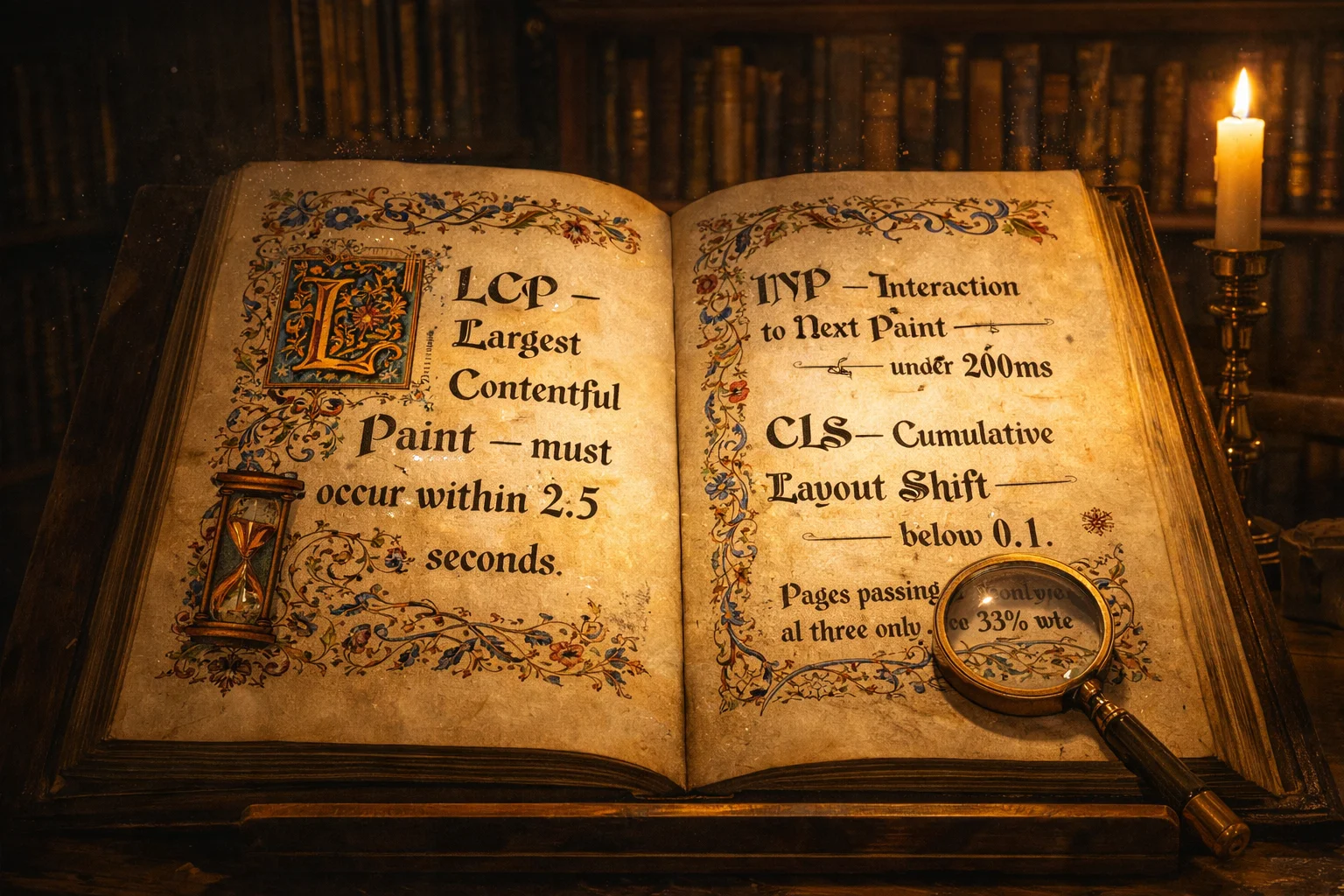
Google's Technical Report Card: Core Web Vitals
Since 2021, Google has published three measurable performance thresholds — the Core Web Vitals — and confirmed that failing them negatively affects ranking. As of 2026, only 33% of websites on the open web pass all three. The other 67% are competing at a structural disadvantage, regardless of how good their content is.
LCP — Largest Contentful Paint
Measures how quickly the main content of a page loads. Google's threshold: under 2.5 seconds. A standard WordPress site with unoptimised images and third-party scripts typically scores 4–8 seconds. A Next.js site with pre-rendered HTML and a CDN-delivered image pipeline typically scores 0.8–1.4 seconds. The difference is not configuration — it is architecture.
INP — Interaction to Next Paint
Replaced FID in March 2024. Measures how quickly a page responds to any user interaction — a click, a tap, a keystroke. Google's threshold: under 200 milliseconds. Heavy JavaScript frameworks that process everything in the browser frequently fail this metric. Server-rendered pages with minimal client-side JavaScript almost always pass it.
CLS — Cumulative Layout Shift
Measures visual stability — how much the page layout jumps around as it loads. A score above 0.1 is considered poor. The most common cause: images without declared dimensions, and web fonts that swap in after the page renders. Both are solved in under ten minutes of engineering. Most agencies never bother.
A site that passes all three Core Web Vitals gets a ranking boost in Google Search. More importantly, Google's internal data shows that sites meeting these thresholds have 24% lower abandonment rates — which feeds back into ranking as a positive engagement signal.
Speaking Google's Native Language: Schema Markup
Keywords are written for humans. JSON-LD Schema markup is written for machines — and it is the single most underused technical SEO lever available to Swiss SMEs today.
When you write "We have a 5-star rating" on your website, Google has to decide whether to believe you. When you inject a LocalBusiness Schema block with aggregateRating structured data, Google has no decision to make — it reads the data directly and displays those five golden stars in the search results automatically.
The business impact is not marginal. Studies across multiple industries show that rich results — star ratings, FAQ dropdowns, breadcrumb trails, price indicators — increase click-through rates by 20–30% compared to plain blue links. You do not need to rank higher to get more clicks. You need to give Google better data.
The Schema types that matter most for Swiss SMEs in 2026:
- LocalBusiness + GeoCoordinates: tells Google exactly where you are and what category you serve — critical for "near me" searches and Google Maps integration.
- Service + Offer: surfaces your services and pricing directly in search results, before the user even clicks.
- FAQPage: expands your search listing with dropdown questions, dramatically increasing result real estate and CTR.
- BreadcrumbList: shows Google the hierarchy of your site, improving crawl efficiency and category ranking.

The JavaScript Trap: SSR vs. CSR
This is the most expensive mistake in modern web development — and the one most agencies never mention, because fixing it requires rebuilding the site.
The majority of modern websites are built with JavaScript frameworks: React, Vue, Angular. These frameworks default to Client-Side Rendering (CSR): the server sends the browser an essentially empty HTML file, and the JavaScript then builds the page content in the browser. For users with fast devices, this is invisible. For Googlebot, it is a problem.
When Googlebot crawls a CSR site, it receives an empty page. It can queue the page for a "second wave" crawl — where it returns later to render the JavaScript — but this second wave is delayed by days or weeks, is not guaranteed, and is severely rate-limited. Google has stated that Googlebot processes JavaScript with "limited resources compared to a modern browser." In practice, studies show that up to 30% of JavaScript-rendered content is never indexed in the second wave.
Server-Side Rendering (SSR) solves this entirely. With SSR — the architecture Next.js uses by default — the server builds the complete, fully-rendered HTML page before sending it to the browser. Googlebot receives the full content on the first request, indexes it immediately, and there is no second wave required. Every page on a Next.js SSR site is as crawlable as a static HTML file from 1999 — with all the speed and interactivity of a modern web app.
If your "modern" website was built with a CSR framework and no SSR configuration, a meaningful portion of your content is invisible to search engines. Your rankings reflect not your full site — but the fraction Google managed to render.

Accessibility and Semantic HTML: The Hidden SEO Layer
In 2026, Google's ranking algorithms and accessibility standards have converged almost entirely. This is not a coincidence — a page that is readable to a screen reader is, by definition, structured in a way that a search engine robot can parse perfectly.
The specific practices that lift both accessibility scores and organic ranking:
- Semantic HTML elements: using
<nav>,<main>,<article>,<section>, and<aside>instead of a sea of generic<div>tags. Google's crawler uses these landmarks to understand the information hierarchy of a page — what is navigation, what is primary content, what is supplementary. - Descriptive alt text on every image: not "image1.jpg" but a genuine description of what the image shows. Google's Vision API reads these and uses them for image search ranking. They also add keyword context to the surrounding content without keyword stuffing.
- Logical heading hierarchy: one
<h1>per page, followed by<h2>sections,<h3>subsections. This is the outline Google uses to understand what a page covers and how to feature it in rich snippets and People Also Ask results. - ARIA labels on interactive elements: buttons, forms, and navigation items labelled correctly. These help both screen readers and Google's interaction simulation when it tests page usability.
None of this is complicated. All of it requires discipline that most template-based builds structurally cannot deliver — because templates generate generic markup at scale, and generic markup is the opposite of semantic structure.
Key Takeaways
- Technical performance is now a ranking factor, not a nice-to-have. Google's Core Web Vitals — LCP under 2.5s, INP under 200ms, CLS below 0.1 — directly affect where your pages appear in search results. Only 33% of websites pass all three.
- Schema markup is free ranking leverage most businesses ignore. Structured data tells Google what your business is, what you offer, and what customers think of you — without asking it to guess. Rich results increase click-through rates by 20–30% without requiring a higher position.
- If your site uses Client-Side Rendering, up to 30% of your content may not be indexed. Server-Side Rendering (Next.js) ensures every page is fully crawlable on the first request. This is not optional in 2026 — it is the foundation.
- Semantic HTML and accessibility practices are SEO practices. The same code structure that makes a site readable for a screen reader makes it perfectly parseable for a search engine. These are not separate disciplines.
- Keywords are the last 5% — not the first. Get the technical architecture right, and your content will rank. Focus only on keywords on a broken technical foundation, and you are decorating a house with no walls.
Book a free technical SEO audit for your website →
Conclusion: Stop Decorating, Start Engineering
Hiring a copywriter to fix your SEO ranking is like repainting a car with a broken engine. The colour is nicer. It still will not move.
The businesses that dominate Swiss search results in 2026 are not the ones with the most blog posts. They are the ones with the fastest pages, the most structured data, the cleanest JavaScript architecture, and the most semantic HTML. These are engineering problems — and they require engineering solutions.
Every website built at Lopes2Tech is a Next.js SSR application with pre-rendered pages, a CDN-distributed image pipeline, JSON-LD Schema on every relevant page type, semantic HTML throughout, and a guaranteed PageSpeed score of 90–100. This is not a premium add-on. It is the baseline.
Because in 2026, technical SEO is not the secret weapon of large enterprises. It is the minimum standard for being found at all.

Paulo Lopes
Founder & CTO
Founder of Lopes2Tech, specializing in AI-powered development workflows and high-performance web applications for Swiss businesses.
Ready to start?
Ready to grow your Swiss business?
We build fast, intelligent websites and systems that generate leads while you sleep. Let's talk about your next project.
Book a free consultation