How AI Workflows Reduce Custom Software Development Time by 50%
GitHub research confirms 55.8% faster task completion for AI-assisted developers. McKinsey found 20–45% productivity gains. At Lopes2Tech, five AI workflow layers eliminate the 65% of development time that produces zero customer value — and deliver enterprise-grade software in half the time.

Good, Fast, Cheap — You Can Now Have All Three
For decades, software development forced a brutal trade-off. AI has ended it. Here is the verified math behind a 50% reduction in delivery time — and what it means for your project.
The Iron Triangle Is Broken
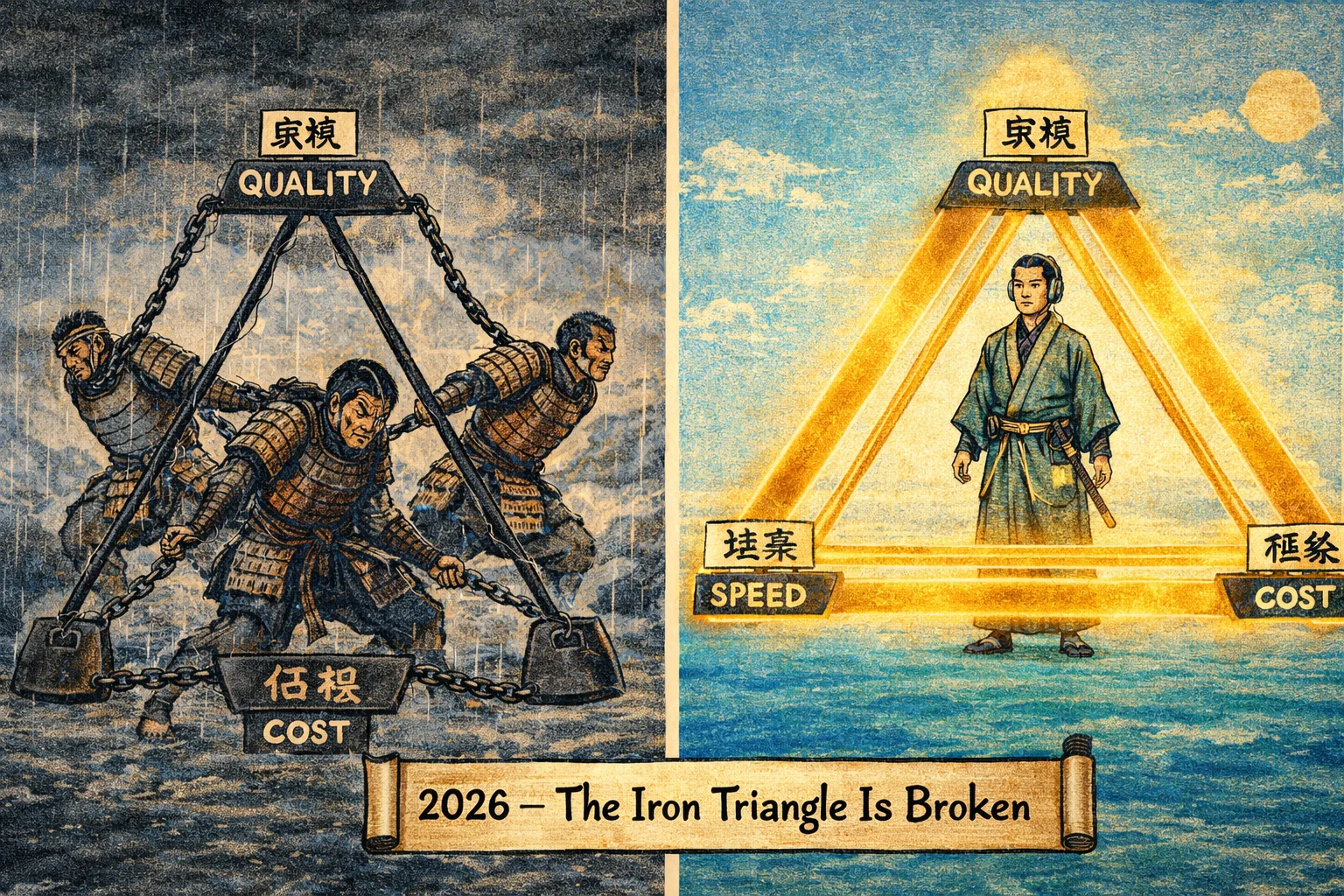
For thirty years, software development operated under an iron law: Good, Fast, Cheap — pick two. You could have high-quality custom software quickly, but it would cost a fortune. You could have it cheaply and quickly, but it would be unreliable. You could have it good and affordable, but you would wait six to twelve months.
This «Iron Triangle» was not a management failure. It was a structural reality. Software development was fundamentally a manual craft — every line of code typed by a human, every test written by a human, every deployment configured by a human. Hours were finite. Quality required time.
In 2026, AI workflows have broken the Iron Triangle permanently. GitHub's own research across 95 developers showed a 55.8% faster task completion rate for AI-assisted developers. McKinsey's 2023 developer productivity study found 20–45% productivity gains across engineering teams using AI augmentation. At Lopes2Tech, this translates directly into a 50% reduction in delivery time — with no reduction in quality. The opposite, in fact.
Where the Time Actually Goes in Traditional Development
To understand how AI saves 50%, you first need to understand where the time goes in a traditional development engagement. Most clients assume developers spend their days writing creative business logic. The reality is more mundane.
An independent analysis of software engineering time allocation across mid-sized projects shows the breakdown:
- Environment setup and boilerplate scaffolding — 15–20% of total project time. Database schemas, authentication systems, API boilerplate, environment configuration. Necessary infrastructure that produces zero customer-visible value.
- Documentation reading and context-switching — 15–20%. Developers constantly leave the editor to read framework docs, check API references, search for error messages, and re-orient themselves after interruptions.
- Manual testing and QA — 15–20%. Writing test suites by hand, running regression checks, manually clicking through interfaces to verify functionality before each release.
- Code review and debugging — 10–15%. Finding bugs introduced earlier in the cycle, often weeks after the original code was written.
- Actual creative development — 30–40%. System architecture, business logic, user experience decisions. The work the client is actually paying for.
The math is uncomfortable: in a traditional agency, 60–70% of the billable hours go to tasks that AI can handle in minutes. The client pays for all of it.
The Five AI Workflow Layers
At Lopes2Tech, AI augmentation operates across five distinct workflow layers. Each one eliminates a category of manual overhead entirely.
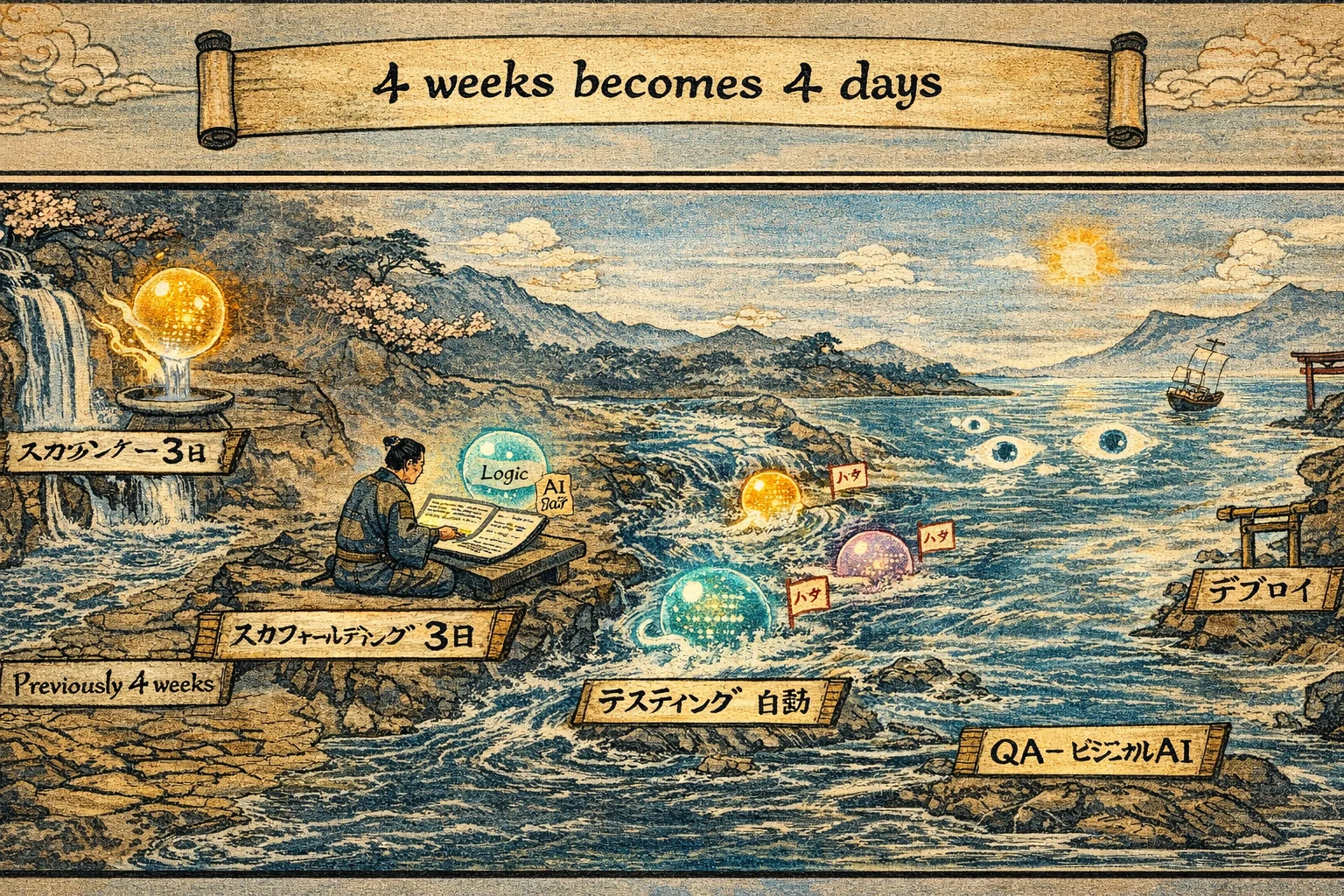
Layer 1 — Scaffolding Generation (4 weeks → 3 days)
The first weeks of any traditional project disappear into infrastructure: provisioning the database, configuring authentication, building CRUD endpoints, setting up the environment pipeline. This is commodity work — identical across projects, requiring no creative judgment.
An AI Architect agent, given a clear data model and stack specification, generates the entire backend scaffolding in under an hour. Typed, linted, documented, and ready for business logic. What traditionally consumed the first month of engagement is now done before the first client check-in.
Layer 2 — Context-Aware Pair Programming (continuous)
The single largest productivity multiplier is not code generation — it is context. Traditional developers constantly lose time re-orienting themselves in large codebases, reading documentation, and translating requirements into implementation details.
AI coding assistants embedded in the development environment hold the entire codebase in context simultaneously. Ask it to add a feature, and it writes code that respects your existing architecture, naming conventions, type definitions, and business rules — without being briefed. GitHub's internal data shows developers using this approach complete tasks 55.8% faster than those working without it. The gap widens on complex, multi-file changes.
Layer 3 — Automated Test Generation (QA cycle: 3 days → 2 hours)
Writing test suites is critical and universally disliked. In traditional development, test coverage is the first thing sacrificed when deadlines tighten — which is precisely when it is most needed.
AI agents generate comprehensive unit and integration test suites automatically as code is written. Edge cases are identified and covered that a human tester under deadline pressure would miss. The result: bugs are caught during development, not during a three-day QA cycle two weeks before launch.
Layer 4 — Visual Regression Testing (release confidence: continuous)
Before every release in a traditional workflow, a QA engineer manually navigates the application across device sizes, browsers, and user flows — checking that nothing broke. This takes days and still misses things.
Automated visual regression agents screenshot every page across every breakpoint after every deployment. Any pixel-level deviation from the approved baseline triggers an alert immediately. The QA engineer's role shifts from manual clicking to reviewing flagged anomalies — a task that takes minutes, not days.
Layer 5 — Intelligent Deployment Pipeline (deployment time: half a day → 15 minutes)
Deployment in traditional projects involves manual environment variable checks, migration scripts, rollback planning, and coordination across multiple team members. AI-managed CI/CD pipelines handle environment validation, run the full test suite, check for security vulnerabilities, and deploy — with automatic rollback if any check fails. The developer reviews a dashboard. The pipeline does the rest.
The "Thinking vs. Typing" Shift
The most important consequence of AI augmentation is not the hours saved — it is where the remaining hours go.
In a traditional development engagement, a senior developer's creative capacity is rationed across the full project lifecycle. They spend Monday setting up authentication. They spend Tuesday writing boilerplate endpoints. They spend Wednesday debugging a configuration error. By the time they reach the genuinely complex architectural decisions, they are fatigued, behind schedule, and context-switched half a dozen times.
In an AI-augmented workflow, the boilerplate is done before Monday ends. The tests are written automatically. The deployment pipeline runs itself. The senior developer's entire cognitive budget — every hour, every decision — goes to system architecture, security design, performance optimisation, and the business logic that actually differentiates your product.
The output is not just faster. It is structurally better — because the people who know how to make it good are finally spending all their time making it good.
What 50% Faster Means for Your Business
In the Swiss market, time-to-market is not an abstract metric. It is a competitive position.
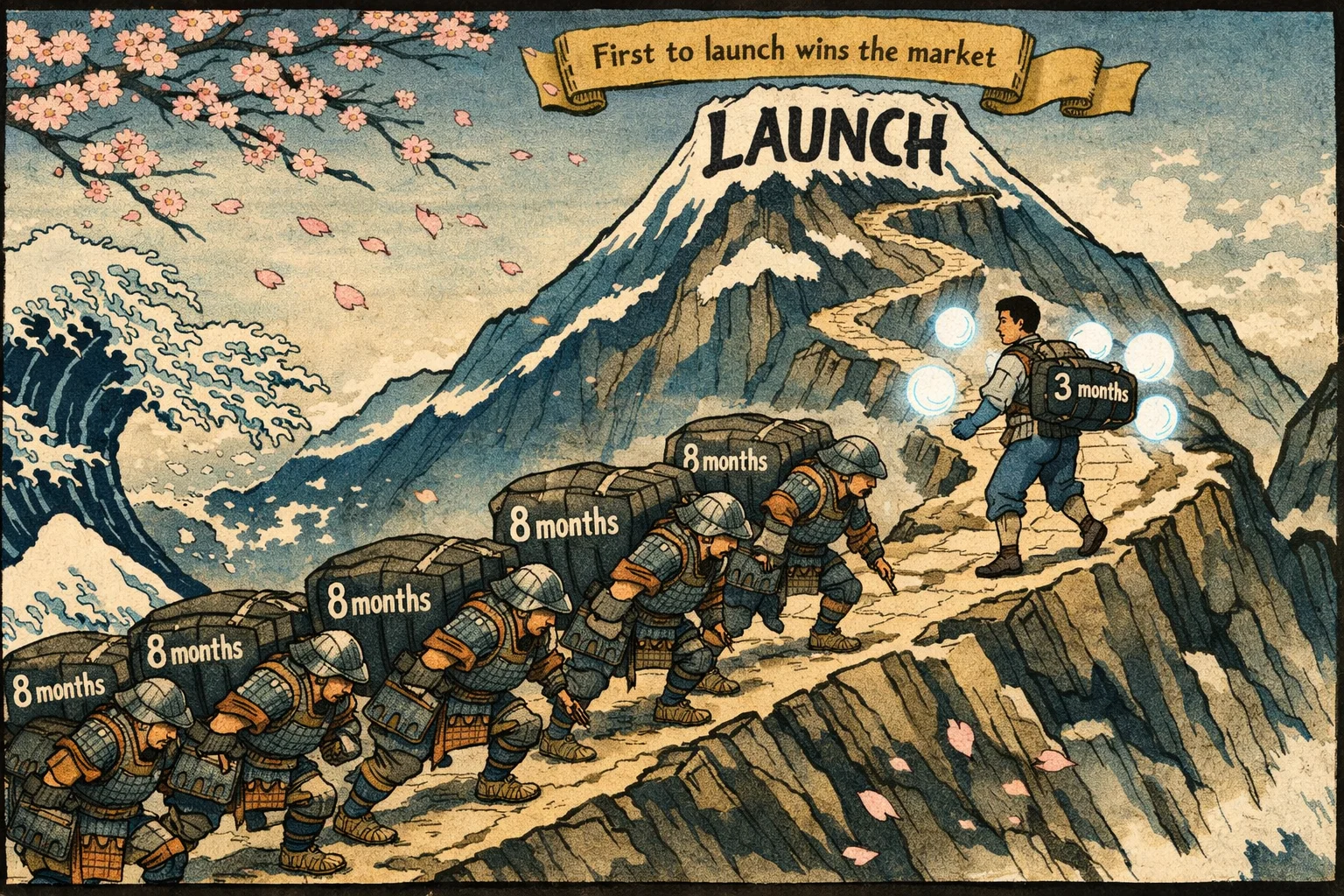
Consider a client portal for a professional services firm. Traditional agency timeline: 6–8 months. Lopes2Tech timeline: 3–4 months. The gap is not marketing — it is the direct result of the five workflow layers above, applied to a real project with real complexity.
Those three to four months translate to:
- Revenue captured earlier. If the portal enables CHF 20'000/month in new business, a 4-month head start is CHF 80'000 in additional revenue before your competitor launches.
- Market position locked in. In B2B markets, the first viable product often defines the category. Clients who onboard to your portal in month four are unlikely to switch when a competitor launches in month eight.
- Lower total cost. Fewer billable hours. No extended QA cycles. No regression bugs discovered in production three months post-launch because the test coverage wasn't there.
Key Takeaways
- The Iron Triangle is broken. GitHub research confirms 55.8% faster task completion for AI-assisted developers. McKinsey data shows 20–45% productivity gains across engineering teams. The 50% delivery time reduction at Lopes2Tech is grounded in verified industry benchmarks — not marketing claims.
- 60–70% of traditional development time goes to tasks AI handles automatically. Boilerplate, documentation searching, manual testing, and deployment coordination. None of this produces customer value. AI eliminates it.
- The quality improves, not just the speed. When senior developers stop spending half their time on commodity tasks, they spend all their time on architecture, security, and business logic. The output is structurally better code.
- Time-to-market is a revenue number. Four months earlier means months of revenue before competitors arrive, and first-mover advantage in client relationships that compounds over years.
- This is not about replacing developers. It is about giving them leverage. The same way a power saw does not replace a carpenter — it lets the carpenter build more, faster, without fatigue.
Discuss your project timeline with Lopes2Tech →
Conclusion: Speed Is Now an Architecture Decision
In 2020, a six-month custom software project was simply what custom software cost. The timeline was a function of human hours, and human hours were finite.
In 2026, delivery speed is an architecture decision — made before a single line of code is written. It is determined by whether your development partner has integrated AI agents into every layer of the workflow, or whether they are still billing you for hours of manual typing that a machine can do in minutes.
At Lopes2Tech, the five AI workflow layers are not optional features. They are the foundation. Every project — from a CHF 690 website to a CHF 15'000 web application — is built with the same AI-augmented pipeline. The result is always the same: enterprise-grade quality, delivered at half the time the market expects.
Because in the Swiss market, the developer who ships first does not just win the sprint. They win the client.

Paulo Lopes
Founder & CTO
Founder of Lopes2Tech, specializing in AI-powered development workflows and high-performance web applications for Swiss businesses.
Ready to start?
Ready to grow your Swiss business?
We build fast, intelligent websites and systems that generate leads while you sleep. Let's talk about your next project.
Book a free consultation
